Technical & Regulatory Resource Hub
Direct access to 2D/3D CAD models, Bureau Veritas Type-Approval certificates, structural load test reports, and SOLAS technical guidance for commercial shipyards and naval architects
REGULATORY COMPLIANCE
Navigating SOLAS & Class Society Watertight Regulations
SOLAS Chapter II-1
SOLAS Chapter II-1 addresses subdivision, stability and watertight integrity, including requirements relating to watertight closures and the control of water ingress.
Seatite deck hatches are Bureau Veritas Type-Approved for watertight applications at a certified pressure of 5.5 psi, equivalent to approximately 12 ft (3.7 m) of water head.
Beyond the certified requirement, Seatite hatches have also been pressure tested at more than 35 psi, equivalent to approximately 80 ft (24 m) of water head.
For ships constructed on or after 1 January 2024, SOLAS Chapter II-1 Regulation 22 requires watertight hatches to be effectively closed and secured watertight before the voyage commences and kept closed during navigation. The master may permit a watertight hatch to be opened temporarily during navigation where required for passage or access, after which it must be closed.

SOLAS Chapter II-2 (Regulation 13)
SOLAS Chapter II-2 Regulation 13 establishes requirements for means of escape so that persons onboard can safely and swiftly escape in an emergency.
Where a Seatite hatch forms part of an emergency escape arrangement, the appropriate Access / Escape configuration should be selected according to the vessel arrangement, installation location and applicable flag-state and classification requirements.
Suitability for use as part of an emergency escape arrangement should be confirmed against the vessel arrangement, installation location, flag-state and applicable classification requirements.
Certification & Technical Documentation
Access Seatite type-approval certification, quality management documentation, independent testing and hatch installation guidance.
Type Approval
Quality Management
Bureau Veritas
Type Approval Certificate
Seatite Marine Hatches
Certificate 76056/B0 BV
LRQA ISO 9001:2015
Certificate
Collins Marine Ltd
Approval No. 00041509
Hatch Assembly
Load Deflection Test
Independent testing by
Curtis Assemble & Test Ltd
Marine Hatch
Installation Guide
Weld-in and bolt-down deck ring installation, inspection and maintenance guidance.
2D & 3D CAD Drawings
Contact Seatite to request technical drawings and CAD files for your hatch requirements. Our team can advise on available documentation and formats to support your design and specification process.
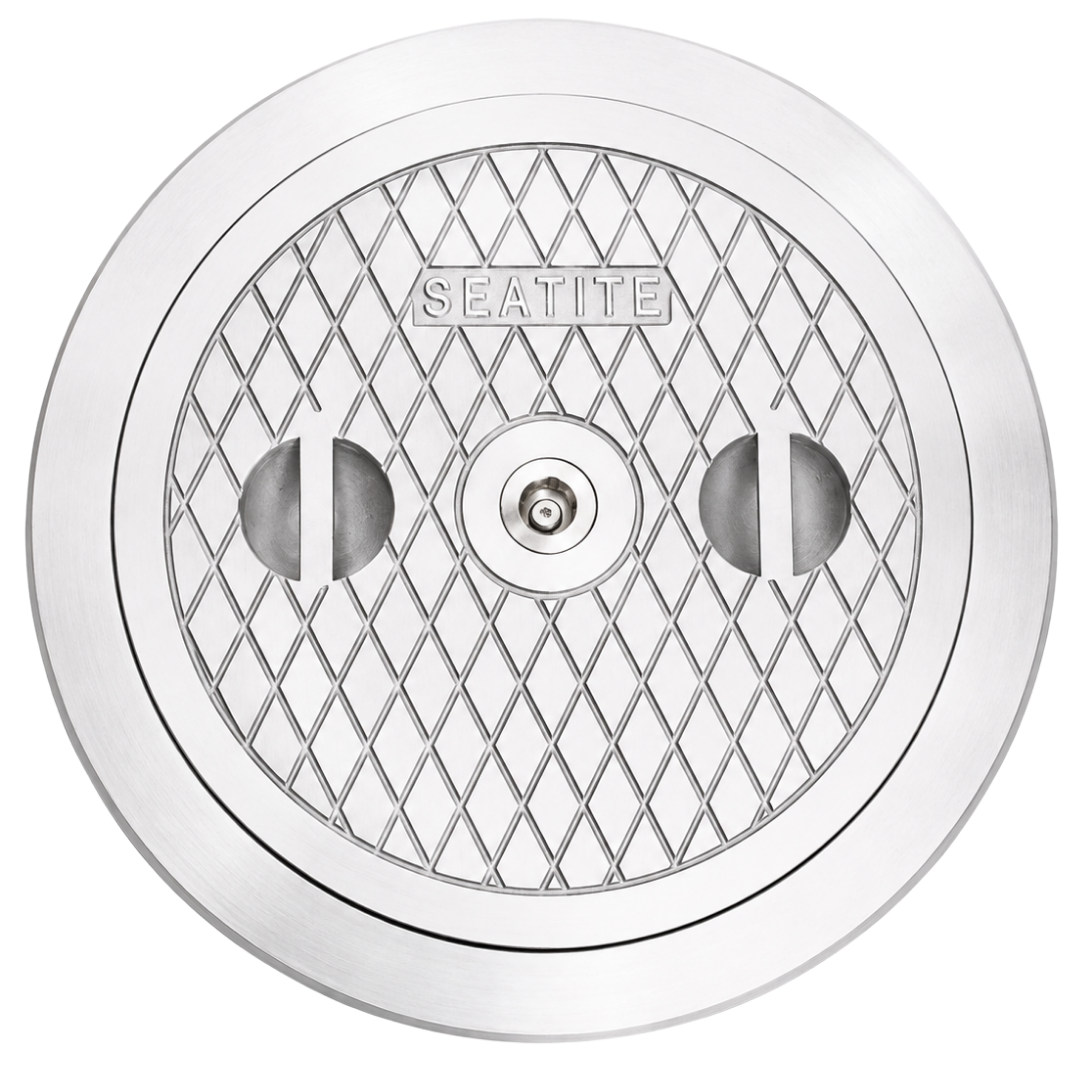
Round Hatches
400 / 500 / 600Request available CAD drawings and technical information for your hatch and installation requirements.
REQUEST ROUND HATCH CAD FILES →
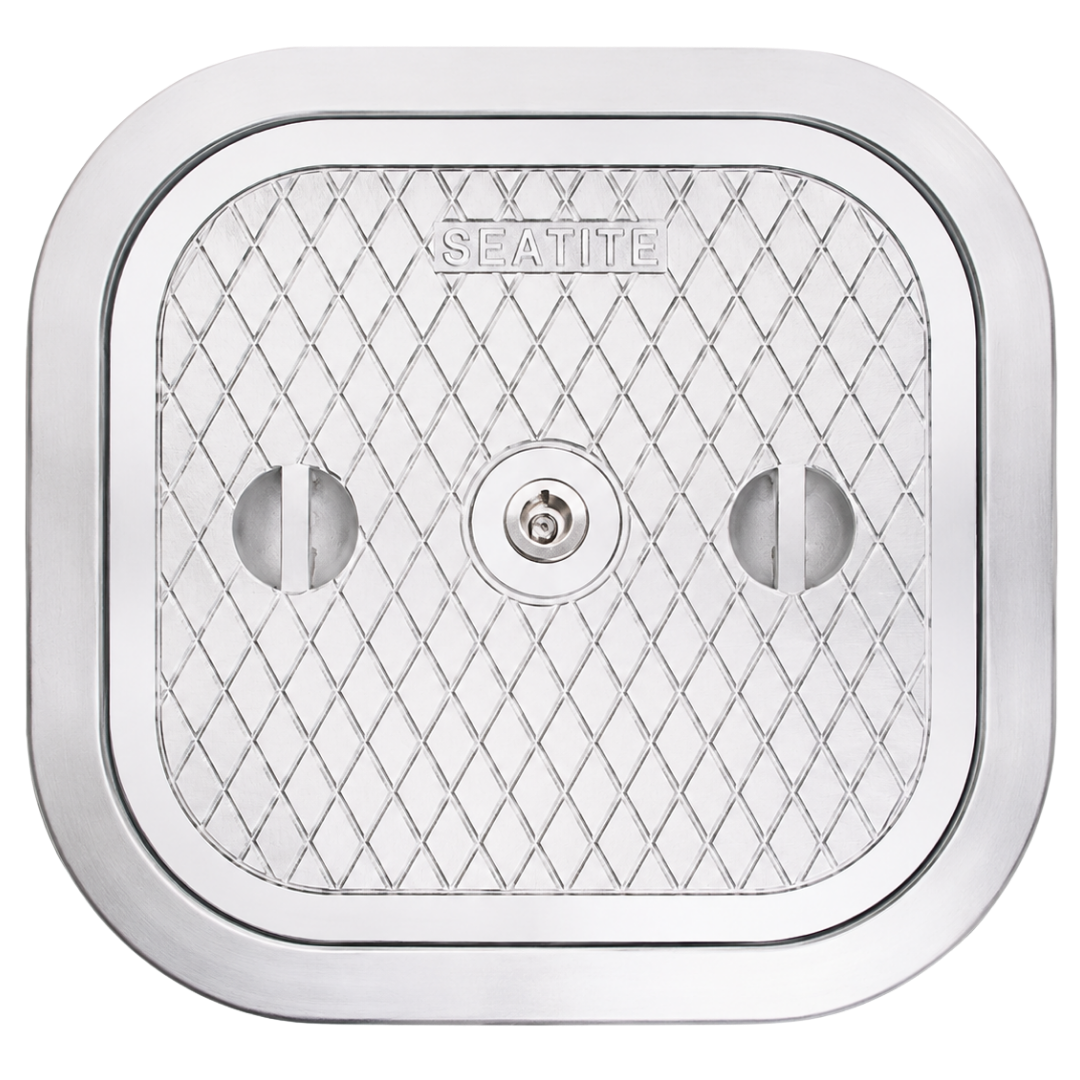
Square Hatches
560 / 675Request available CAD drawings and technical information for your hatch and installation requirements.
REQUEST SQUARE HATCH CAD FILES →
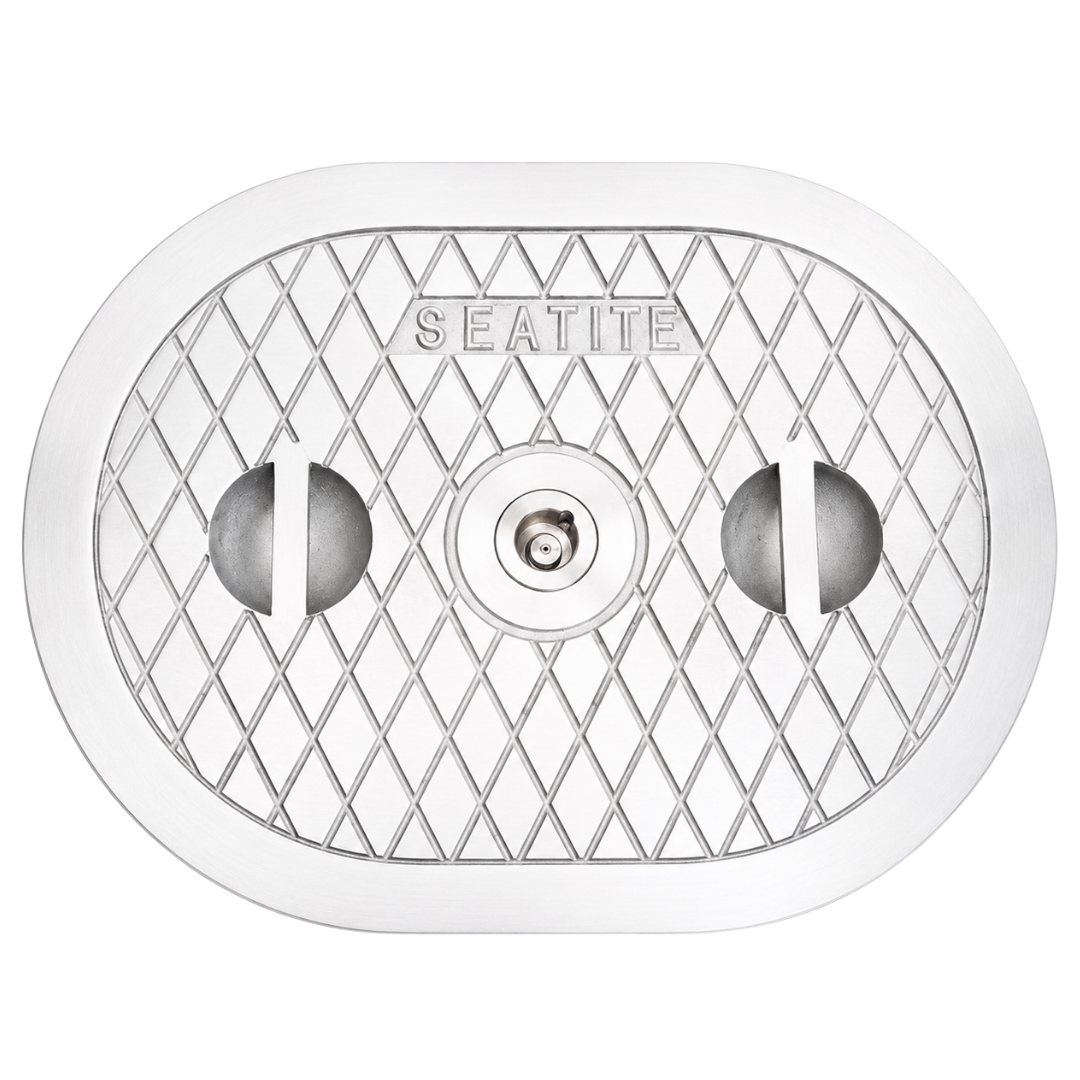
Oval Hatches
650 × 500Request available CAD drawings and technical information for your hatch and installation requirements.
REQUEST OVAL HATCH CAD FILES →How the square locking hatch actually locks

A twist-lock strong back under the lid, a spring-loaded stop, and two cam lobes that wedge under the frame lip when the handle turns.
Seven parts, one spindle
Everything stacks on a single central boss that passes through the lid: T-bar key on top, lid below it, then spring, bush and strong back underneath, with the frame at the base holding it all together. Tap to explode the stack and see how it sits together.
- T-bar key
- Lid
- Bolt
- Preload spring
- Nylon bush / stop
- Strong back arms
- Frame & lip
Turning the handle rotates the strong back
Looking up through the frame: the frame lip is solid on two sides, with a cutout opposite each side sized for the cam lobes to pass through. Turning the handle swings the strong back so its lobes leave the cut-outs and wedge under the solid lip, pulling the lid down onto the gasket. The nylon bush stops the rotation dead at each end.
Technical FAQS
Frequently Asked Questions
Quick answers to common technical, compliance and specification questions.
What is the technical difference between Bureau Veritas watertight certification and standard CE weathertight ratings?
The key distinction is the level of water protection and the intended installation environment.
ISO 12216
Designed to resist external rain, spray and water exposure appropriate to the hatch's designated installation area.
Bureau Veritas Type Approval
Seatite hatches are type-approved for watertight applications, providing structural protection against hydrostatic water pressure.
How do Seatite deck hatches comply with SOLAS Chapter II-2 (Regulation 13) emergency escape route requirements?
SOLAS Chapter II-2 Regulation 13 addresses means of escape so that persons onboard can safely and swiftly escape in an emergency. Seatite hatches can be supplied in dedicated Access / Escape configurations for applications where the hatch forms part of an emergency escape arrangement.
Final suitability should be confirmed against the vessel arrangement, installation location, flag-state and applicable classification requirements.
What 2D and 3D CAD formats are available for shipyard integration, and how do I obtain deck cut-out templates?
Seatite technical resources are available in multiple formats to support shipyard design, specification and integration workflows.
CAD resources can be used to check deck clearances, installation geometry, coaming arrangements and hatch integration before fabrication.
How do direct-weld steel deck rings accelerate shipyard build timelines compared to aluminium frames?
For installation into steel deck structures, Seatite can be supplied with fabricated mild-steel deck rings designed to be welded directly into the deck plating.
Aluminium Deck Ring
A mechanically fixed installation option for applications where welding directly into the deck structure is not appropriate.
Fabricated Steel Deck Ring
Designed to integrate directly with steel deck plating, providing shipyards with a straightforward steel-to-steel installation method.
Are Seatite hatches independently load-tested for heavy deck traffic and workboat loading?
Yes. Seatite hatch construction has undergone independent physical load testing by Curtis Assemble & Test Ltd (CAT) to assess structural behaviour under significant applied loading.
The test provides independent evidence of the hatch's structural performance under substantial loading and supports specification for demanding commercial marine environments.
What material traceability and quality documentation is supplied for 5-Year Class Renewal (Special Surveys)?
Seatite combines marine-grade materials with documented quality controls and traceability to support vessel construction, maintenance and classification requirements.
Material traceability is maintained through the manufacturing process, providing supporting documentation where required for project and classification records.
Need a custom solution or have a project to discuss?
Our engineering team is ready to support your specification and procurement requirements.
LONG-TERM RELIABILITY
Designed for dependable marine service.
Type Approved
Bureau Veritas certified.
Trusted Worldwide
Installed on commercial vessels globally.
Expert Support
Engineering support from concept to sea.
LONG-TERM RELIABILITY
Designed for dependable marine service.
Type Approved
Bureau Veritas certified.
Trusted Worldwide
Installed on commercial vessels globally.
Expert Support
Engineering support from concept to sea.